The text read off it
[page 12]
Character Set
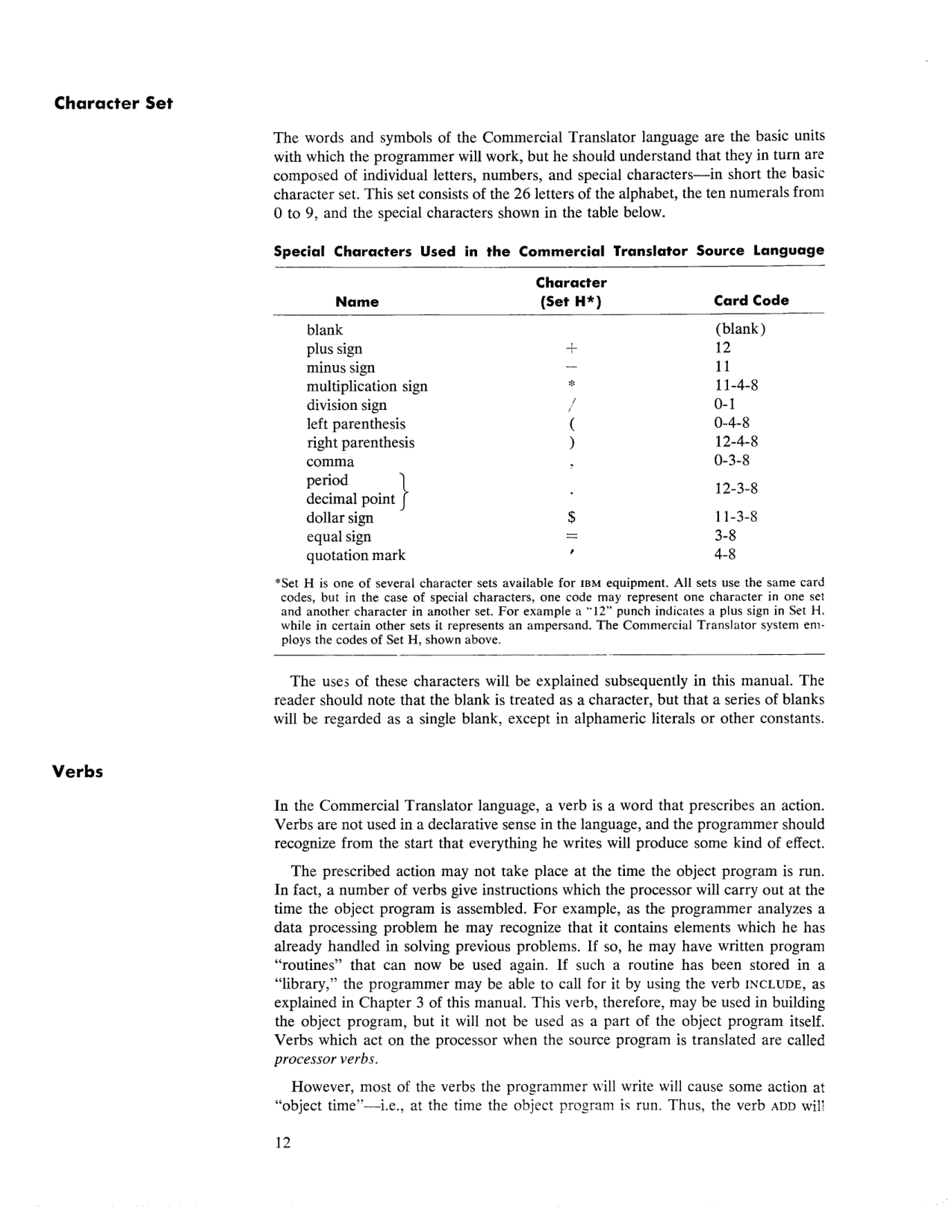
The words and symbols of the Commercial Translator language are the basic units with which the programmer will work, but he should understand that they in turn are composed of individual letters, numbers, and special characters—in short the basic character set. This set consists of the 26 letters of the alphabet, the ten numerals from 0 to 9, and the special characters shown in the table below.
Special Characters Used in the Commercial Translator Source Language
| Name | Character (Set H*) | Card Code |
|---|---|---|
| blank | (blank) | |
| plus sign | + | 12 |
| minus sign | - | 11 |
| multiplication sign | * | 11-4-8 |
| division sign | / | 0-1 |
| left parenthesis | ( | 0-4-8 |
| right parenthesis | ) | 12-4-8 |
| comma | , | 0-3-8 |
| period / decimal point | . | 12-3-8 |
| dollar sign | $ | 11-3-8 |
| equal sign | = | 3-8 |
| quotation mark | ' | 4-8 |
Notes —
- Set H is one of several character sets available for IBM equipment. All sets use the same card codes, but in the case of special characters, one code may represent one character in one set and another character in another set. For example a "12" punch indicates a plus sign in Set H, while in certain other sets it represents an ampersand. The Commercial Translator system employs the codes of Set H, shown above.
The uses of these characters will be explained subsequently in this manual. The reader should note that the blank is treated as a character, but that a series of blanks will be regarded as a single blank, except in alphameric literals or other constants.
Verbs
In the Commercial Translator language, a verb is a word that prescribes an action. Verbs are not used in a declarative sense in the language, and the programmer should recognize from the start that everything he writes will produce some kind of effect.
The prescribed action may not take place at the time the object program is run. In fact, a number of verbs give instructions which the processor will carry out at the time the object program is assembled. For example, as the programmer analyzes a data processing problem he may recognize that it contains elements which he has already handled in solving previous problems. If so, he may have written program "routines" that can now be used again. If such a routine has been stored in a "library," the programmer may be able to call for it by using the verb INCLUDE, as explained in Chapter 3 of this manual. This verb, therefore, may be used in building the object program, but it will not be used as a part of the object program itself. Verbs which act on the processor when the source program is translated are called processor verbs.
However, most of the verbs the programmer will write will cause some action at "object time"—i.e., at the time the object program is run.