The text read off it
[page 21]
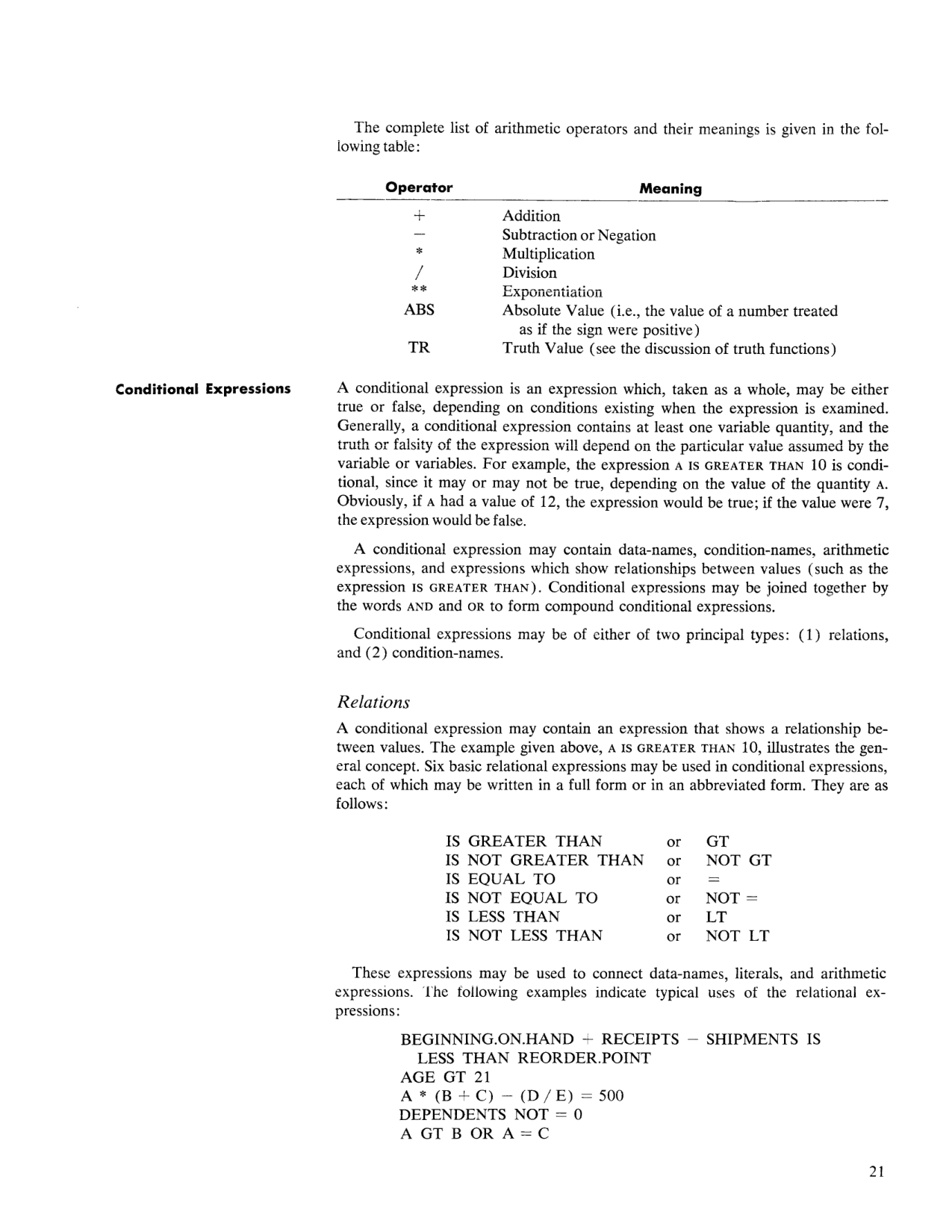
The complete list of arithmetic operators and their meanings is given in the following table:
| Operator | Meaning |
|---|---|
| + | Addition |
| - | Subtraction or Negation |
| * | Multiplication |
| / | Division |
| ** | Exponentiation |
| ABS | Absolute Value (i.e., the value of a number treated as if the sign were positive) |
| TR | Truth Value (see the discussion of truth functions) |
Conditional Expressions
A conditional expression is an expression which, taken as a whole, may be either true or false, depending on conditions existing when the expression is examined. Generally, a conditional expression contains at least one variable quantity, and the truth or falsity of the expression will depend on the particular value assumed by the variable or variables. For example, the expression A IS GREATER THAN 10 is conditional, since it may or may not be true, depending on the value of the quantity A. Obviously, if A had a value of 12, the expression would be true; if the value were 7, the expression would be false.
A conditional expression may contain data-names, condition-names, arithmetic expressions, and expressions which show relationships between values (such as the expression IS GREATER THAN). Conditional expressions may be joined together by the words AND and OR to form compound conditional expressions.
Conditional expressions may be of either of two principal types: (1) relations, and (2) condition-names.
Relations
A conditional expression may contain an expression that shows a relationship between values. The example given above, A IS GREATER THAN 10, illustrates the general concept. Six basic relational expressions may be used in conditional expressions, each of which may be written in a full form or in an abbreviated form. They are as follows:
| Relational expression | Abbreviated form |
|---|---|
| IS GREATER THAN | GT |
| IS NOT GREATER THAN | NOT GT |
| IS EQUAL TO | = |
| IS NOT EQUAL TO | NOT = |
| IS LESS THAN | LT |
| IS NOT LESS THAN | NOT LT |
These expressions may be used to connect data-names, literals, and arithmetic expressions. The following examples indicate typical uses of the relational expressions:
BEGINNING.ON.HAND + RECEIPTS - SHIPMENTS IS
  LESS THAN REORDER.POINT
AGE GT 21
A * (B + C) - (D / E) = 500
DEPENDENTS NOT = 0
A GT B OR A = C