The text read off it
[page 65]
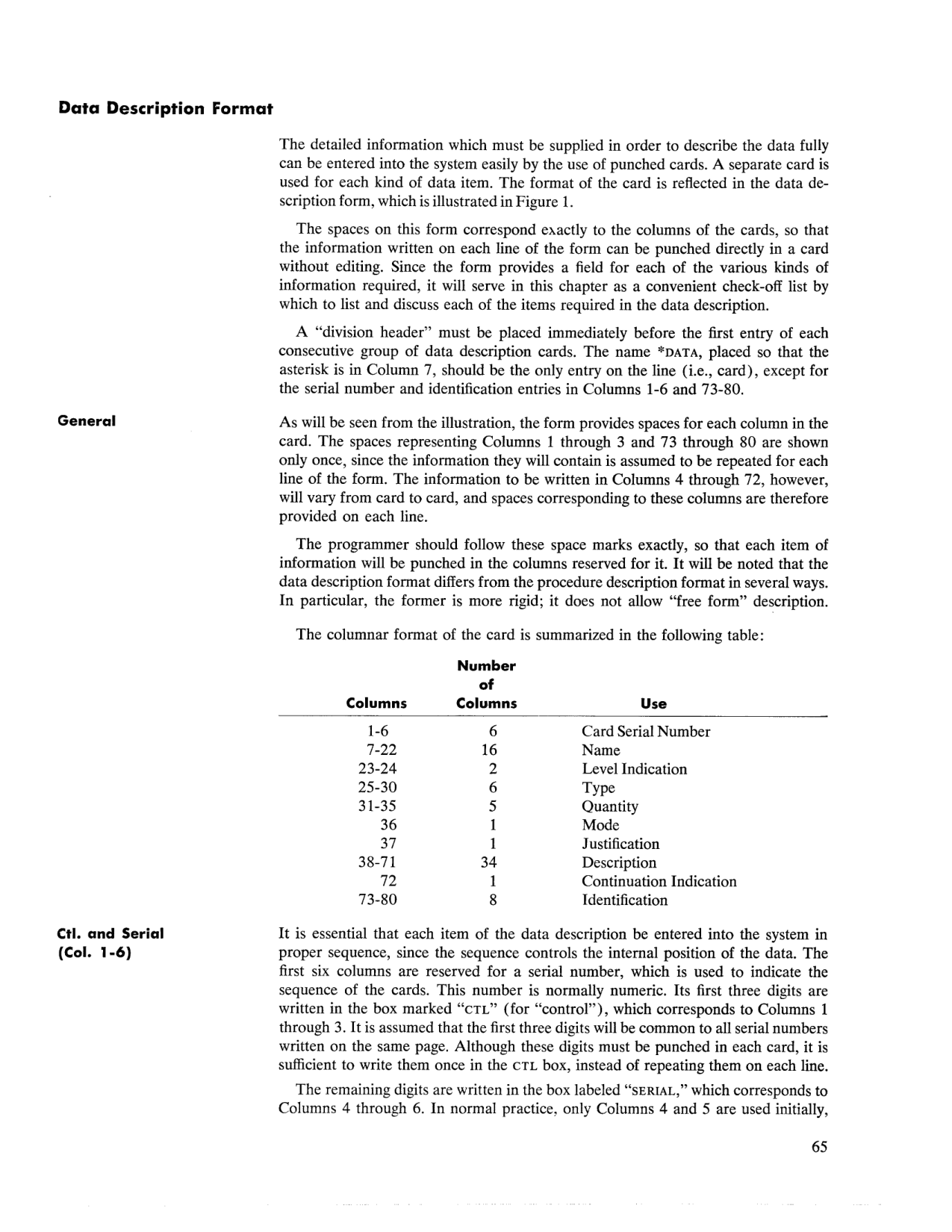
The detailed information which must be supplied in order to describe the data fully can be entered into the system easily by the use of punched cards. A separate card is used for each kind of data item. The format of the card is reflected in the data description form, which is illustrated in Figure 1.
The spaces on this form correspond exactly to the columns of the cards, so that the information written on each line of the form can be punched directly in a card without editing. Since the form provides a field for each of the various kinds of information required, it will serve in this chapter as a convenient check-off list by which to list and discuss each of the items required in the data description.
A "division header" must be placed immediately before the first entry of each consecutive group of data description cards. The name *DATA, placed so that the asterisk is in Column 7, should be the only entry on the line (i.e., card), except for the serial number and identification entries in Columns 1-6 and 73-80.
General
As will be seen from the illustration, the form provides spaces for each column in the card. The spaces representing Columns 1 through 3 and 73 through 80 are shown only once, since the information they will contain is assumed to be repeated for each line of the form. The information to be written in Columns 4 through 72, however, will vary from card to card, and spaces corresponding to these columns are therefore provided on each line.
The programmer should follow these space marks exactly, so that each item of information will be punched in the columns reserved for it. It will be noted that the data description format differs from the procedure description format in several ways. In particular, the former is more rigid; it does not allow "free form" description.
The columnar format of the card is summarized in the following table:
| Columns | Number of Columns | Use |
|---|---|---|
| 1-6 | 6 | Card Serial Number |
| 7-22 | 16 | Name |
| 23-24 | 2 | Level Indication |
| 25-30 | 6 | Type |
| 31-35 | 5 | Quantity |
| 36 | 1 | Mode |
| 37 | 1 | Justification |
| 38-71 | 34 | Description |
| 72 | 1 | Continuation Indication |
| 73-80 | 8 | Identification |
Ctl. and Serial (Col. 1-6)
It is essential that each item of the data description be entered into the system in proper sequence, since the sequence controls the internal position of the data. The first six columns are reserved for a serial number, which is used to indicate the sequence of the cards. This number is normally numeric. Its first three digits are written in the box marked "CTL" (for "control"), which corresponds to Columns 1 through 3. It is assumed that the first three digits will be common to all serial numbers written on the same page. Although these digits must be punched in each card, it is sufficient to write them once in the CTL box, instead of repeating them on each line.
The remaining digits are written in the box labeled "SERIAL," which corresponds to Columns 4 through 6. In normal practice, only Columns 4 and 5 are used initially,