The text read off it
[page 77]
The effect of this entry would be as though the programmer had written an entirely new set of entries in the following form:
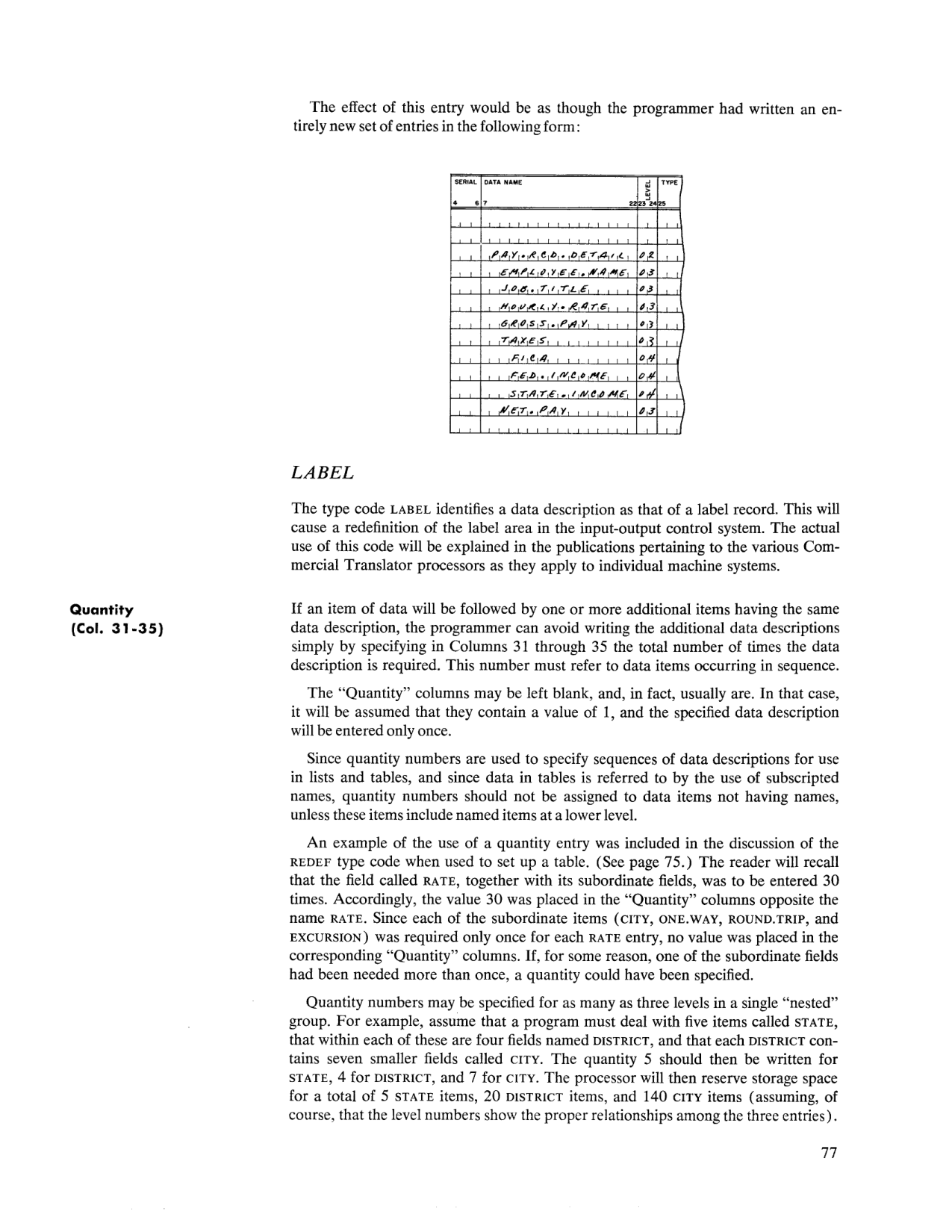 Data description coding form — PAY.RCD.DETAIL as expanded by the COPY operation (page 77).
SERIAL   DATA NAME                    LEVEL  TYPE

         PAY.RCD.DETAIL                 02
         EMPLOYEE.NAME                  03
         JOB.TITLE                      03
         HOURLY.RATE                    03
         GROSS.PAY                      03
         TAXES                          03
         FICA                           04
         FED.INCOME                     04
         STATE.INCOME                   04
         NET.PAY                        03
LABEL
The type code LABEL identifies a data description as that of a label record. This will cause a redefinition of the label area in the input-output control system. The actual use of this code will be explained in the publications pertaining to the various Commercial Translator processors as they apply to individual machine systems.
Quantity (Col. 31-35)
If an item of data will be followed by one or more additional items having the same data description, the programmer can avoid writing the additional data descriptions simply by specifying in Columns 31 through 35 the total number of times the data description is required. This number must refer to data items occurring in sequence.
The "Quantity" columns may be left blank, and, in fact, usually are. In that case, it will be assumed that they contain a value of 1, and the specified data description will be entered only once.
Since quantity numbers are used to specify sequences of data descriptions for use in lists and tables, and since data in tables is referred to by the use of subscripted names, quantity numbers should not be assigned to data items not having names, unless these items include named items at a lower level.
An example of the use of a quantity entry was included in the discussion of the REDEF type code when used to set up a table. (See page 75.) The reader will recall that the field called RATE, together with its subordinate fields, was to be entered 30 times. Accordingly, the value 30 was placed in the "Quantity" columns opposite the name RATE. Since each of the subordinate items (CITY, ONE.WAY, ROUND.TRIP, and EXCURSION) was required only once for each RATE entry, no value was placed in the corresponding "Quantity" columns. If, for some reason, one of the subordinate fields had been needed more than once, a quantity could have been specified.
Quantity numbers may be specified for as many as three levels in a single "nested" group. For example, assume that a program must deal with five items called STATE, that within each of these are four fields named DISTRICT, and that each DISTRICT contains seven smaller fields called CITY. The quantity 5 should then be written for STATE, 4 for DISTRICT, and 7 for CITY. The processor will then reserve storage space for a total of 5 STATE items, 20 DISTRICT items, and 140 CITY items (assuming, of course, that the level numbers show the proper relationships among the three entries).