The text read off it
[page 80]
| Format Character | Meaning and Use |
|---|---|
A |
Any non-numeric character, including the blank. |
X |
Alphameric character (any character in the machine's character set). |
9 |
Any numeric character. |
8 |
Numeric character, to be replaced automatically by a blank whenever it is a non-significant zero. |
* |
Numeric character, to be replaced automatically by an asterisk whenever it is a non-significant zero. |
V |
Assumed decimal point. This character informs the processor where the decimal point is located, for purposes of calculation and/or alignment of values. The symbol is not required for integers. The symbol V will not reserve an actual space in storage. |
. |
True decimal point. This character will reserve an actual space in storage. |
S |
Scale factor. This symbol is used as a "filler" or "spacer" when the input data does not show the position of the decimal point. E.g., a field containing percentages from 1 to 9 would be represented by the notation VS9; this would assure that the values 1 to 9 would be interpreted as .01 to .09. Similarly, if a field contains values that represent thousands, each unspecified digit must be represented by an S; thus, the notation 999SSS would provide for values from 000,000 to 999,000, even though the three right-hand zeros would not appear as input. |
$ |
Dollar sign. An actual dollar sign will be placed in the indicated position, provided it is not followed by the symbol 8. In the latter case, the dollar sign will "float"—i.e., it will be placed immediately to the left of the first significant digit remaining. |
, |
True comma. This symbol will reserve an actual space in storage, to be occupied by the comma. The comma itself may be replaced by a blank, asterisk, or dollar sign, if the operation of a preceding 8 or * has resulted in the elimination of non-significant zeros to the left. |
+ |
Plus or minus sign, one of which will always be placed in the space reserved for it, depending on whether the value is positive or negative. (Compare with use of minus sign, described below.) This sign may be placed in a column by itself, in which case it will reserve an actual space in storage. Alternatively, it may be entered as an "overpunch" with either of the format characters 8 or 9, in either the units or high-order position of a field; in this case, a special space will not be reserved, and the sign of the field will be indicated in accordance with the operating characteristics of the particular system. |
- |
Minus sign, to be placed in the space reserved for it when the value is negative; when the value is positive, the space will be left blank. If punched in a space by itself, this symbol will reserve a space in memory; otherwise, it may be "overpunched" and will act as described in the rules for the symbol +. |
F |
Floating point number. This symbol does not reserve an actual space in storage; it informs the processor that the number being described is a floating point number. It is placed between the format characters representing the fraction and those representing the exponent. E.g., +99V9F+99. |
(n) |
A number placed in parentheses immediately following one of the other format characters instructs the processor to allow for that number of the character specified. E.g., 9(4)A(12) is equivalent to 9999AAAAAAAAAAAA. |
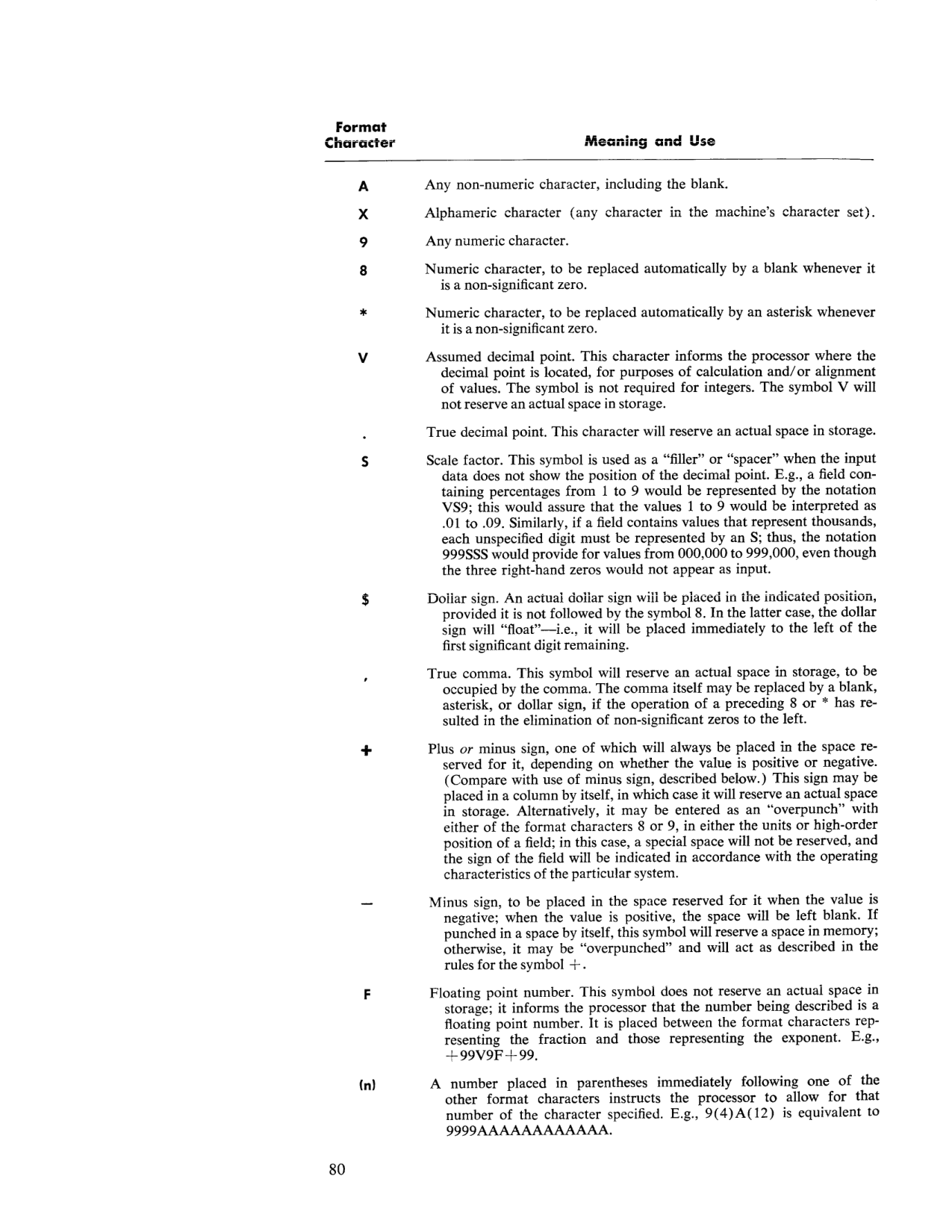 Format Characters table (page 80).