The text read off it
[page 106]
Second Symbol
| First Symbol | C | OR | AND | NOT | ( | ) |
|---|---|---|---|---|---|---|
| C | 0 | 1 | 1 | 0 | 0 | 1 |
| OR | 1 | 0 | 0 | 1 | 1 | 0 |
| AND | 1 | 0 | 0 | 1 | 1 | 0 |
| NOT | 1 | 0 | 0 | 0 | 1 | 0 |
| ( | 1 | 0 | 0 | 1 | 1 | 0 |
| ) | 0 | 1 | 1 | 0 | 0 | 1 |
where the "1" indicates that the pair is permissible, and the "0" indicates a symbol pair that is not permissible. Thus, the pair "OR NOT" is permissible, while "NOT OR" is not permissible.
Rules for Forming Arithmetic Expressions
Arithmetic expressions may contain the names of variables, constants and functions , also literals and conditional expressions, joined by arithmetic operators. Subexpressions may be contained in parentheses as required. The rules for forming arithmetic expressions are as follows:
- The basic operators are:
| Binary Operator | Written as |
|---|---|
| Addition | + |
| Subtraction | − |
| Multiplication | * |
| Division | / |
| Exponentiation | ** |
| Unary Operator | Written as |
|---|---|
| Negation | − |
| Absolute Value | ABS |
| Truth Value | TR |
- The ways in which symbol pairs may be formed are summarized in the following table:
Second Symbol
| First Symbol | Variable | + − * / ** | ABS, TR | Negation − | ( | ) |
|---|---|---|---|---|---|---|
| Variable | 0 | 1 | 0 | 0 | 0 | 1 |
| + − * / ** | 1 | 0 | 1 | 0 | 1 | 0 |
| ABS, TR | 1 | 0 | 0 | 0 | 1 | 0 |
| Negation − | 1 | 0 | 0 | 0 | 1 | 0 |
| ( | 1 | 0 | 1 | 1 | 1 | 0 |
| ) | 0 | 1 | 0 | 0 | 0 | 1 |
where "1" indicates a permissible symbol pair, and "0" indicates a pair which is not permitted. Thus, "* (" is permissible, while "( *" is not.
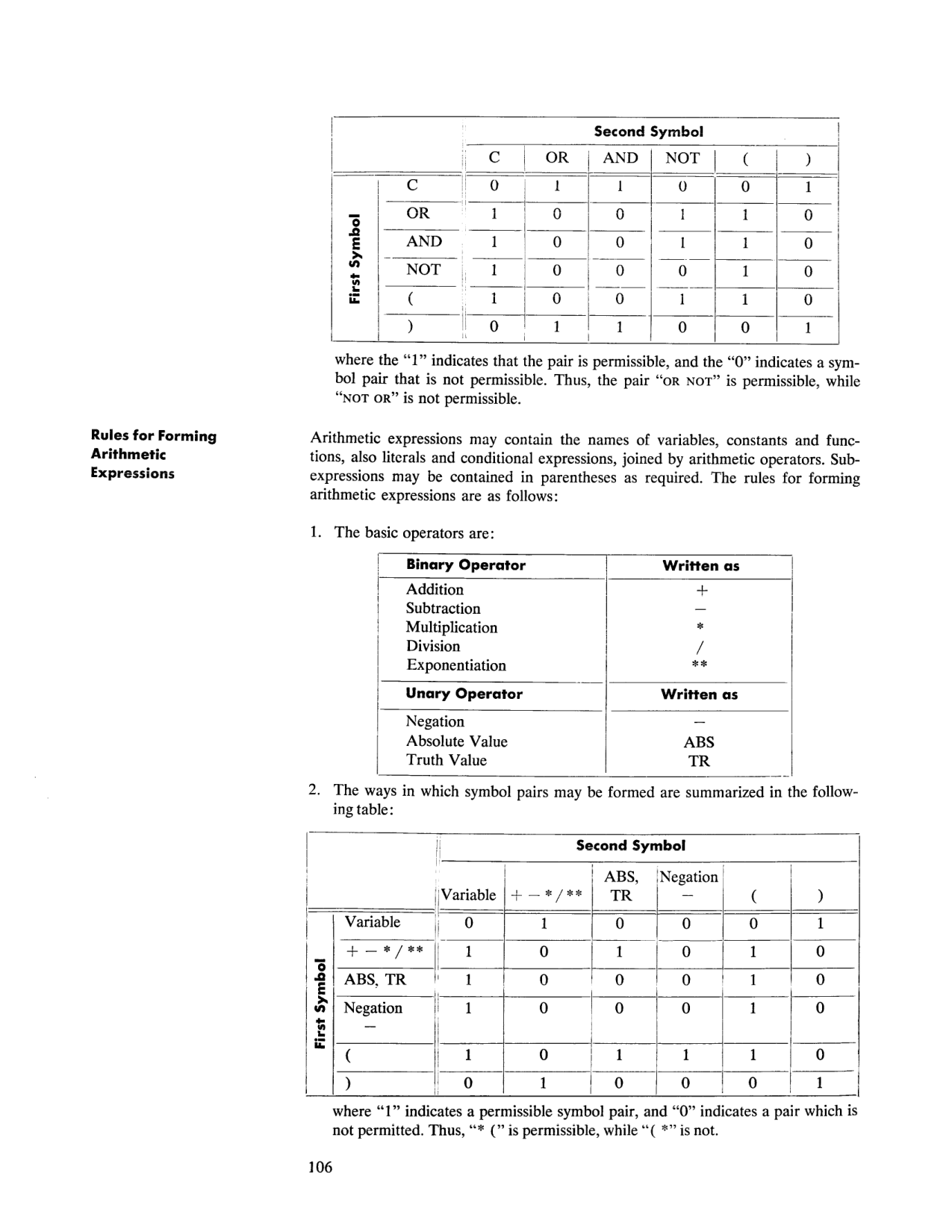 Symbol-pair tables: conditional-expression symbols (top) and arithmetic-expression symbols (bottom) (page 106).