The text read off it
[02.04.02]
The following chart shows the result of MOVEing and SETting figurative constants into variously defined target fields. (See 02.05 for description of the target fields).
| Figurative Constant | Alphameric | External Decimal | Internal Decimal | Edited Field | Floating Point | Scientific Decimal |
|---|---|---|---|---|---|---|
| BLANK or BLANKS | blanks | blanks* | 0's* | blanks* | 0's* | blanks* |
| ZERO or ZEROS | 0's | 0's | 0's | 0's Edited | 0's | 0's Edited |
| LOW.VALUE or LOW.VALUES | 0's# or blanks | 0's #* or blanks | Illegal* | 0's #* or blanks | Illegal* | 0's #* or blanks |
| HIGH.VALUE or HIGH.VALUES | ('s# or 9's | ('s #* or 9's | Illegal* | ('s #* or 9's | Illegal* | ('s #* or 9's |
Notes —
- * An error message is given for each doubtful or illegal usage.
- # Value dependent upon collating sequence order specified (Commercial or 709).
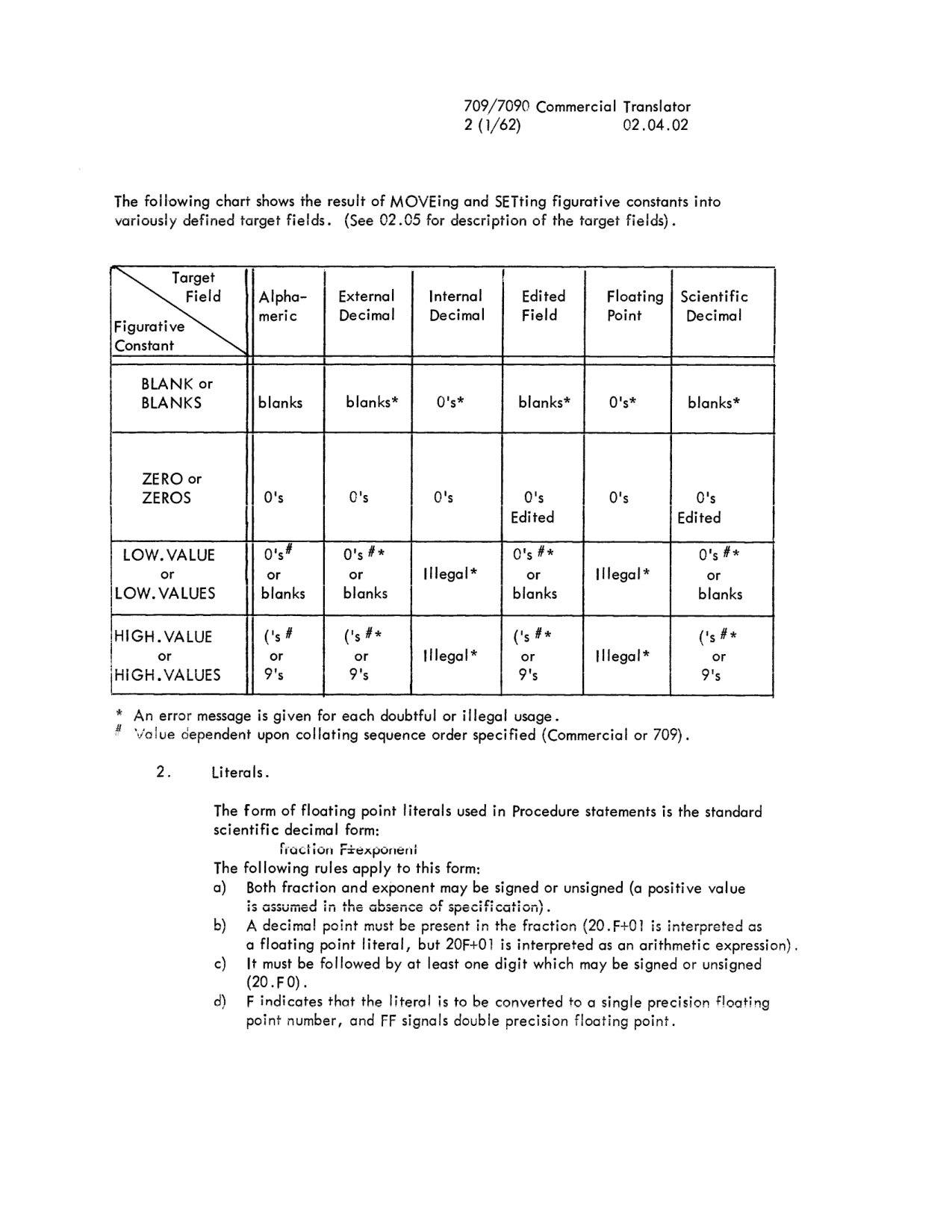 Chart: result of MOVEing and SETting figurative constants into variously defined target fields (page 18).
2. Literals.
The form of floating point literals used in Procedure statements is the standard scientific decimal form:
fraction F±exponent
The following rules apply to this form:
a) Both fraction and exponent may be signed or unsigned (a positive value is assumed in the absence of specification).
b) A decimal point must be present in the fraction (20.F+01 is interpreted as a floating point literal, but 20F+01 is interpreted as an arithmetic expression).
c) It must be followed by at least one digit which may be signed or unsigned (20.F0).
d) F indicates that the literal is to be converted to a single precision floating point number, and FF signals double precision floating point.