The text read off it
[02.06.03]
-
Input Files
Name        Type    Description

file.name   FILE    INPUT    [ ,{BCD}    ]    [ ,{CARD} ]
                              [  {BINARY} ]    [  {TAPE} ]

                     ,BLOCKSIZE nn

                     [ ,ON ERROR statement.name.1 ]
                     [ ,FOR LABEL statement.name.2 ]
                     [ ,{HOLD}  ]    [ ,BEGIN ]
                        {SPANS}

                     ,record.name.1        nj

                     [ ,{BLOCK CONTROL}               ]
                     [  {FIND LENGTH IN data.name.1}  ]
                     [ ,PLACE LENGTH IN data.name.2   ]

                     [ record.name.2 . . . ]
[Resolved by scan re-verification, 2026-08-01.] The mark
njafter,record.name.1is genuine type on the page — full-strength, right-reading, and baseline-aligned with the form text (not bleed-through, which would print mirrored); a tiny trailing mark formerly read as a period is a dust speck, not a character. It corresponds to no defined syntax element and its purpose is unknown (stray keystroke, abandoned annotation, or erasure remnant); it is reproduced in the code block above per the fidelity rule.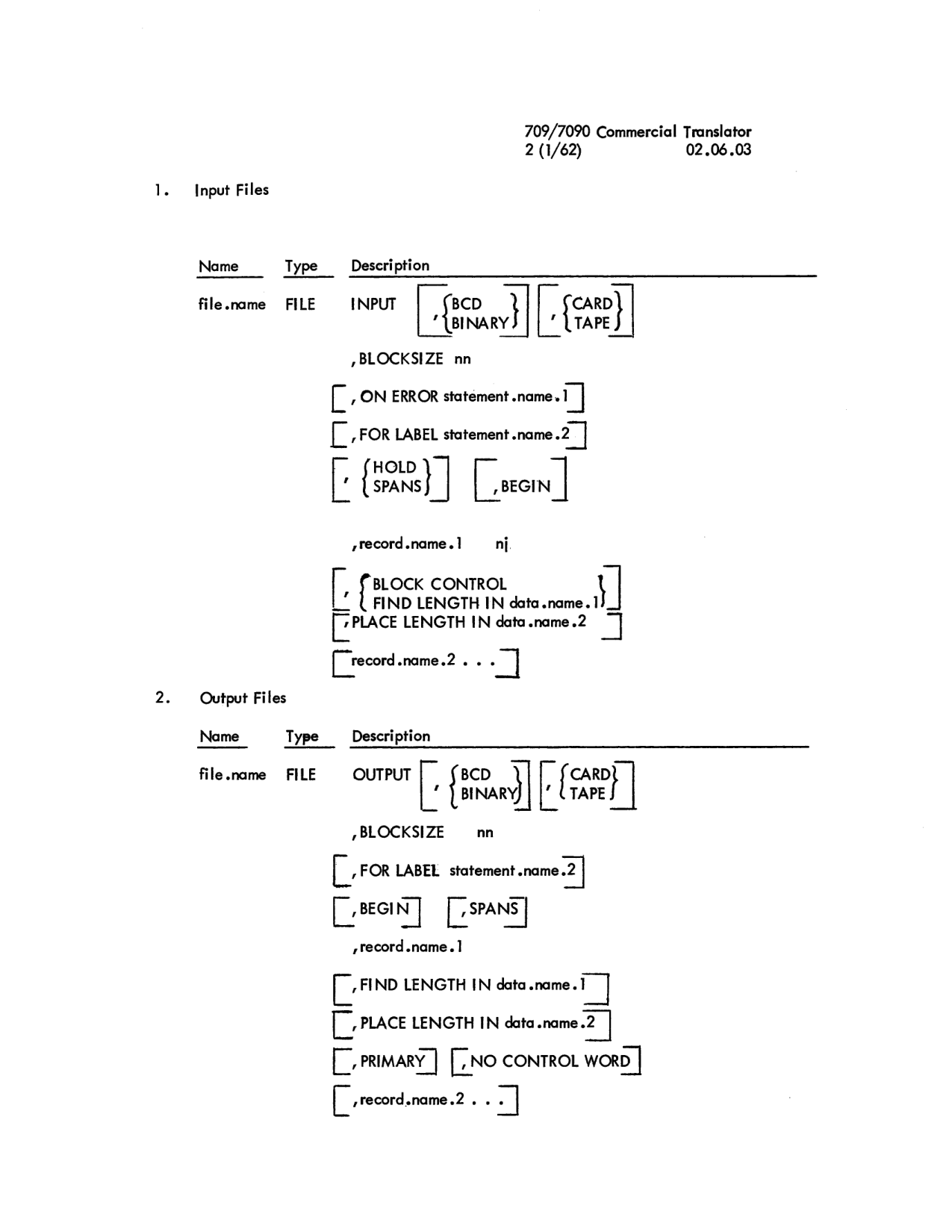 FILE card general forms for Input Files and Output Files (page 37).
-
Output Files
Name        Type    Description

file.name   FILE    OUTPUT   [ ,{BCD}    ]    [ ,{CARD} ]
                              [  {BINARY} ]    [  {TAPE} ]

                     ,BLOCKSIZE nn

                     [ ,FOR LABEL statement.name.2 ]

                     [ ,BEGIN ]    [ ,SPANS ]

                     ,record.name.1

                     [ ,FIND LENGTH IN data.name.1  ]
                     [ ,PLACE LENGTH IN data.name.2 ]
                     [ ,PRIMARY ]    [ ,NO CONTROL WORD ]

                     [ ,record.name.2 . . . ]