The text read off it
[02.06.12]
The SERIAL, REEL, and RETAIN options may be specified for files with either standard or non-standard labels; this information is kept in the IOCS file block and is printed on-line in certain error situations. It is used by IOCS in checking and preparing standard labels (but not non-standard labels) and may be used by the programmer in checking and preparing non-standard labels.
Note: careful study of the IOCS manual and Appendix 90.07 of this bulletin is essential for understanding standard and non-standard labels.
[, SERIAL 'ser.no']
The alphameric literal 'ser.no' is composed of 5 or less characters. Standard input labels will be checked against this serial number if a non-blank literal is specified. Standard output lables written by IOCS for this file will contain this serial number only if the REEL option specifies a 'reel.no' greater than 1; output serial numbers are normally taken from the label already present on the tape on which the first reel of the file is written.
[, REEL 'reel.no']
The alphameric literal 'reel.no' is composed of 4 or less numeric characters. Use of this option specifies the reel sequence number of the first reel of a file. When the option is not exercised this sequence number is assumed to be 1. Reel sequence number is adjusted at object time to reflect reel switching, and is checked in standard input labels.
[, RETAIN days]
The numeric literal, days, is composed of 3 or less numeric characters which specify the number of days a tape is to be retained from the date it was written.
An attempt to write a labeled file on this tape before the end of the period has expired will result in an on-line error message from IOCS. Unless a labeled file is to be written on a tape, the system assumes that no label is present on the tape.
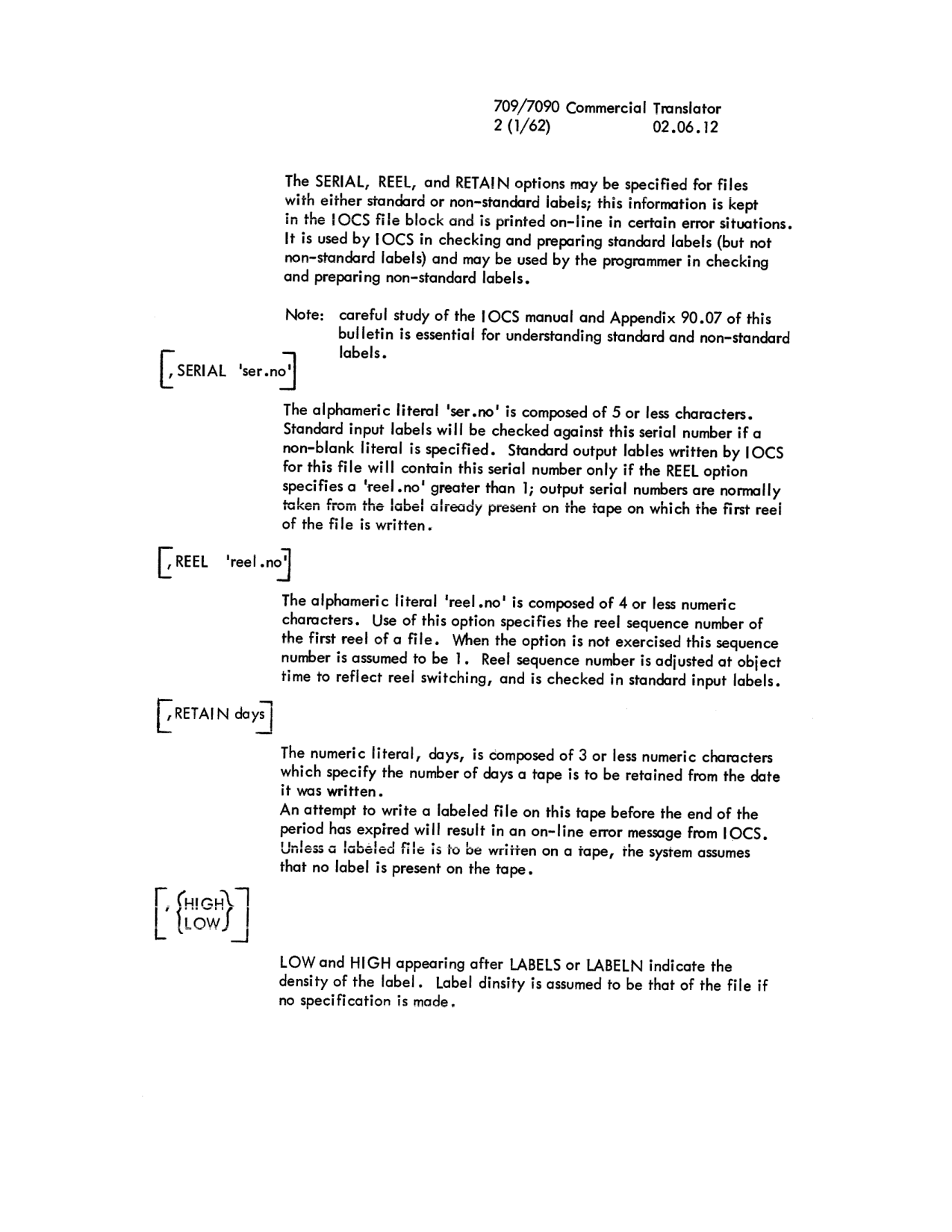
[, {HIGH}]
   {LOW }
LOW and HIGH appearing after LABELS or LABELN indicate the density of the label. Label dinsity is assumed to be that of the file if no specification is made.