The text read off it
[02.06.16]
CONTRL areas which are defined by procedure sections or sentences should be identical up to and including the last externally referenced procedure statement name. If there are no external references made to names inside the areas in any of the programs to be merged (i.e., if references are made to the section name or beginning sentence name only), no correspondence of organization is necessary inside the CONTRL area.
- c) Indices inside a CONTRL area must not be referenced or modified outside of that area in any of the programs to be merged.
H. OPTION Environment Cards
- OPTION cards may be used to set compilation mode switches within the compiler. The lowest to the highest value in the collating sequence of the 709/7090 is:
0 through 9  =  '  +  A through I  0̅  .  )  −  J through R  0̅  $  *  blank  /  S through Z
                                                                              ‡  ,  (
[Transcription uncertain for some special 709/7090 print-train characters in this collating-sequence display — see page image. Overbar (0̅) marks a special (non-alphameric) character position in this chart, not a numeral.]
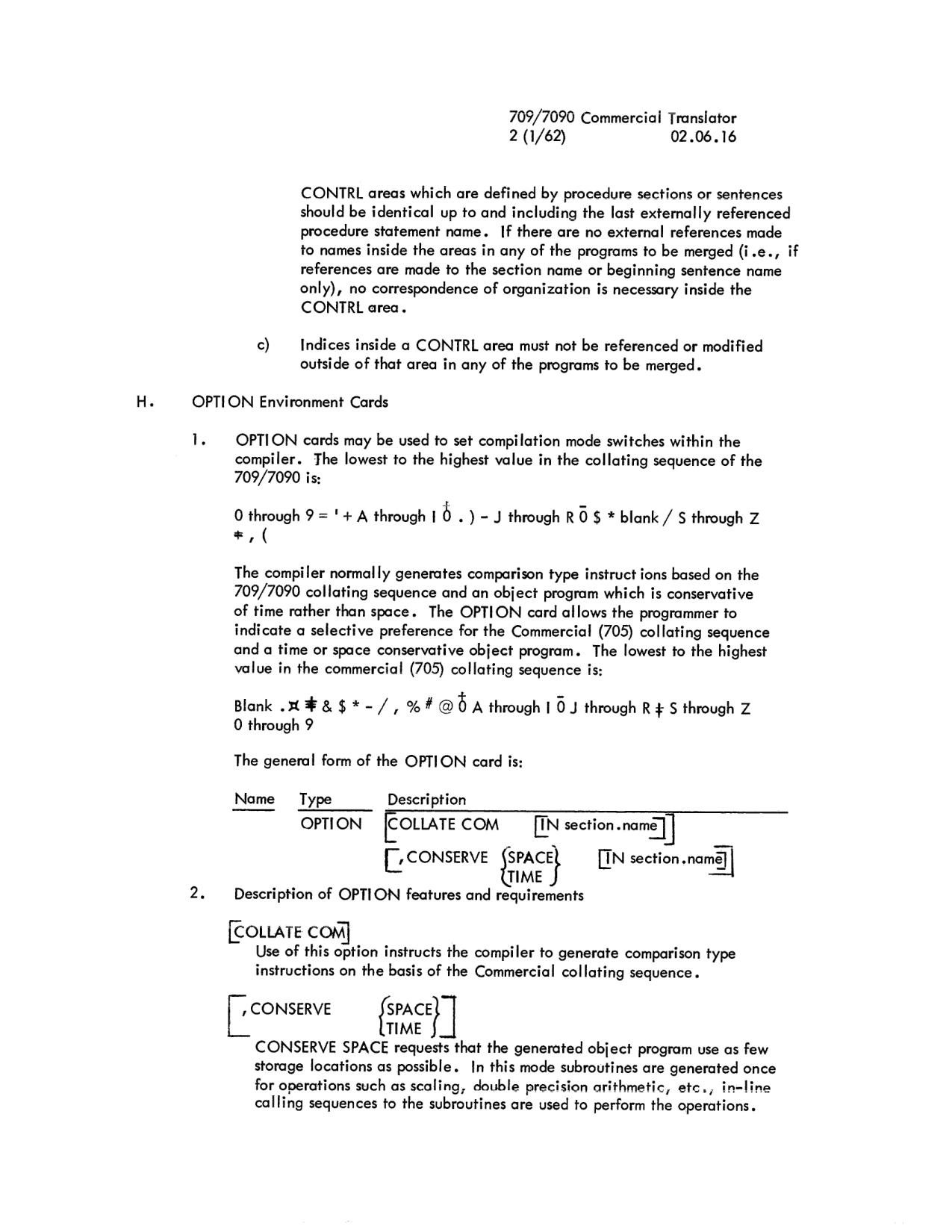 Collating sequence notation, 709/7090 native and Commercial (705) order (page 50).
The compiler normally generates comparison type instructions based on the 709/7090 collating sequence and an object program which is conservative of time rather than space. The OPTION card allows the programmer to indicate a selective preference for the Commercial (705) collating sequence and a time or space conservative object program. The lowest to the highest value in the commercial (705) collating sequence is:
Blank  .  ×  ‡  &  $  *  −  /  ,  %  #  @  0̅  A through I  0̅  J through R  ‡  S through Z
0 through 9
[Transcription uncertain for some special characters in this line — see page image above.]
- The general form of the OPTION card is:
Name   Type     Description

       OPTION   [COLLATE COM]                 [IN section.name]

                [, CONSERVE {SPACE}]           [IN section.name]
                            {TIME }
Description of OPTION features and requirements
[COLLATE COM]
Use of this option instructs the compiler to generate comparison type instructions on the basis of the Commercial collating sequence.
[, CONSERVE {SPACE}]
            {TIME }
CONSERVE SPACE requests that the generated object program use as few storage locations as possible. In this mode subroutines are generated once for operations such as scaling, double precision arithmetic, etc., in-line calling sequences to the subroutines are used to perform the operations.