The text read off it
[03.02.01]
03.02 Loader Control Cards
A. Introduction
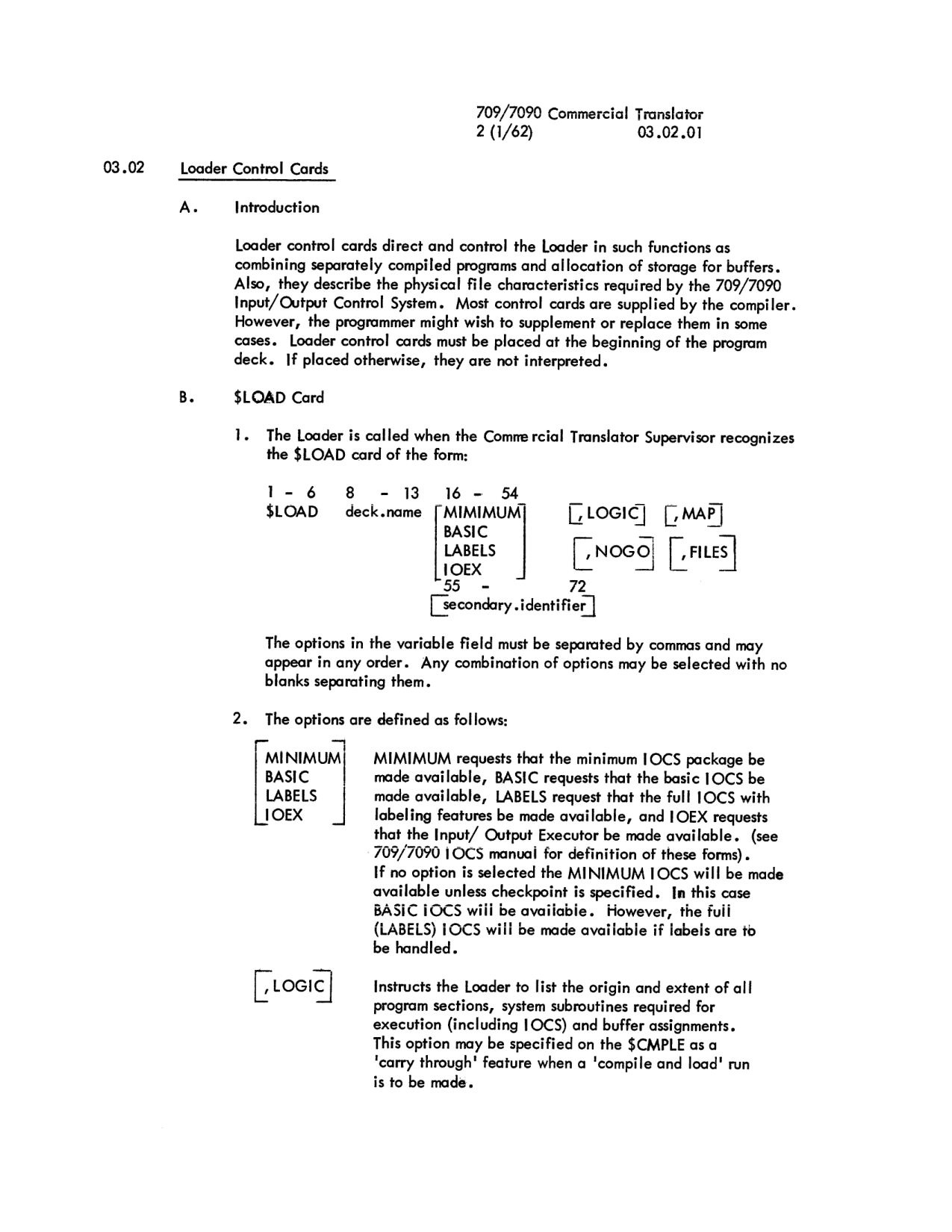
Loader control cards direct and control the Loader in such functions as combining separately compiled programs and allocation of storage for buffers. Also, they describe the physical file characteristics required by the 709/7090 Input/Output Control System. Most control cards are supplied by the compiler. However, the programmer might wish to supplement or replace them in some cases. Loader control cards must be placed at the beginning of the program deck. If placed otherwise, they are not interpreted.
B. $LOAD Card
- The Loader is called when the Commercial Translator Supervisor recognizes the $LOAD card of the form:
1-6     8-13        16                                              54
$LOAD   deck.name   [MIMIMUM                        [,LOGIC]  [,MAP]
                      BASIC
                      LABELS                         [,NOGO]  [,FILES]
                      IOEX]
                     55                                             72
                     [secondary.identifier]
The options in the variable field must be separated by commas and may appear in any order. Any combination of options may be selected with no blanks separating them.
-
The options are defined as follows:
MINIMUM / BASIC / LABELS / IOEX
MIMIMUM requests that the minimum IOCS package be made available, BASIC requests that the basic IOCS be made available, LABELS request that the full IOCS with labeling features be made available, and IOEX requests that the Input/Output Executor be made available. (See 709/7090 IOCS manual for definition of these forms.) If no option is selected the MINIMUM IOCS will be made available unless checkpoint is specified. In this case BASIC IOCS will be available. However, the full (LABELS) IOCS will be made available if labels are to be handled.
[,LOGIC]
Instructs the Loader to list the origin and extent of all program sections, system subroutines required for execution (including IOCS) and buffer assignments. This option may be specified on the $CMPLE as a 'carry through' feature when a 'compile and load' run is to be made.