The text read off it
[04.01.04]
B. Basic Monitor Control Cards
The notation employed in discussing these control cards (and others in the Bulletin) is as follows:
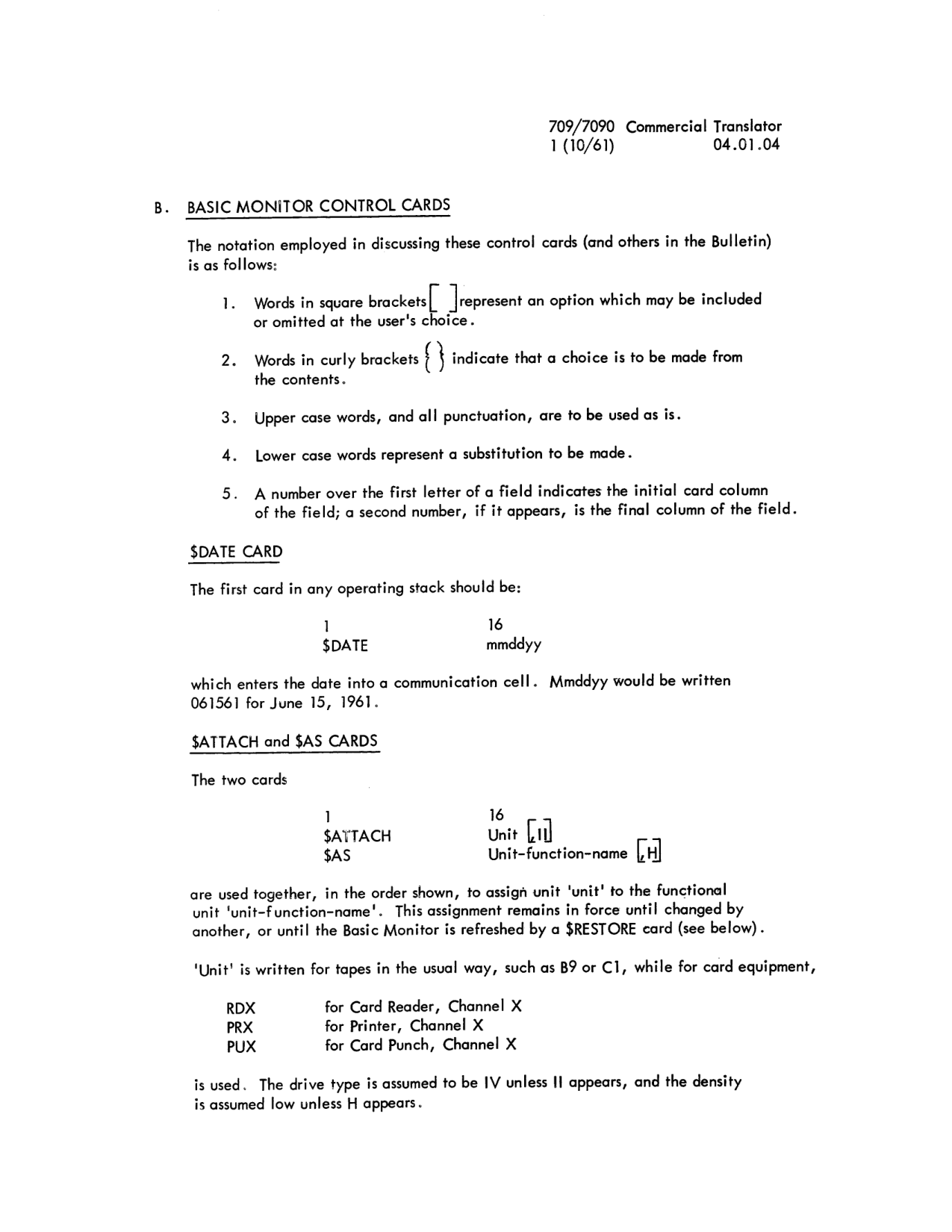
- Words in square brackets
[ ]represent an option which may be included or omitted at the user's choice. - Words in curly brackets
{ }indicate that a choice is to be made from the contents. - Upper case words, and all punctuation, are to be used as is.
- Lower case words represent a substitution to be made.
- A number over the first letter of a field indicates the initial card column of the field; a second number, if it appears, is the final column of the field.
$DATE Card
The first card in any operating stack should be:
1                16
$DATE            mmddyy
which enters the date into a communication cell. Mmddyy would be written 061561 for June 15, 1961.
$ATTACH and $AS Cards
The two cards
1                16
$ATTACH          Unit [,II]
$AS              Unit-function-name [,H]
are used together, in the order shown, to assign unit 'unit' to the functional unit 'unit-function-name'. This assignment remains in force until changed by another, or until the Basic Monitor is refreshed by a $RESTORE card (see below).
'Unit' is written for tapes in the usual way, such as B9 or C1, while for card equipment,
RDX      for Card Reader, Channel X
PRX      for Printer, Channel X
PUX      for Card Punch, Channel X
is used. The drive type is assumed to be IV unless II appears, and the density is assumed low unless H appears.