The text read off it
[90.01.05]
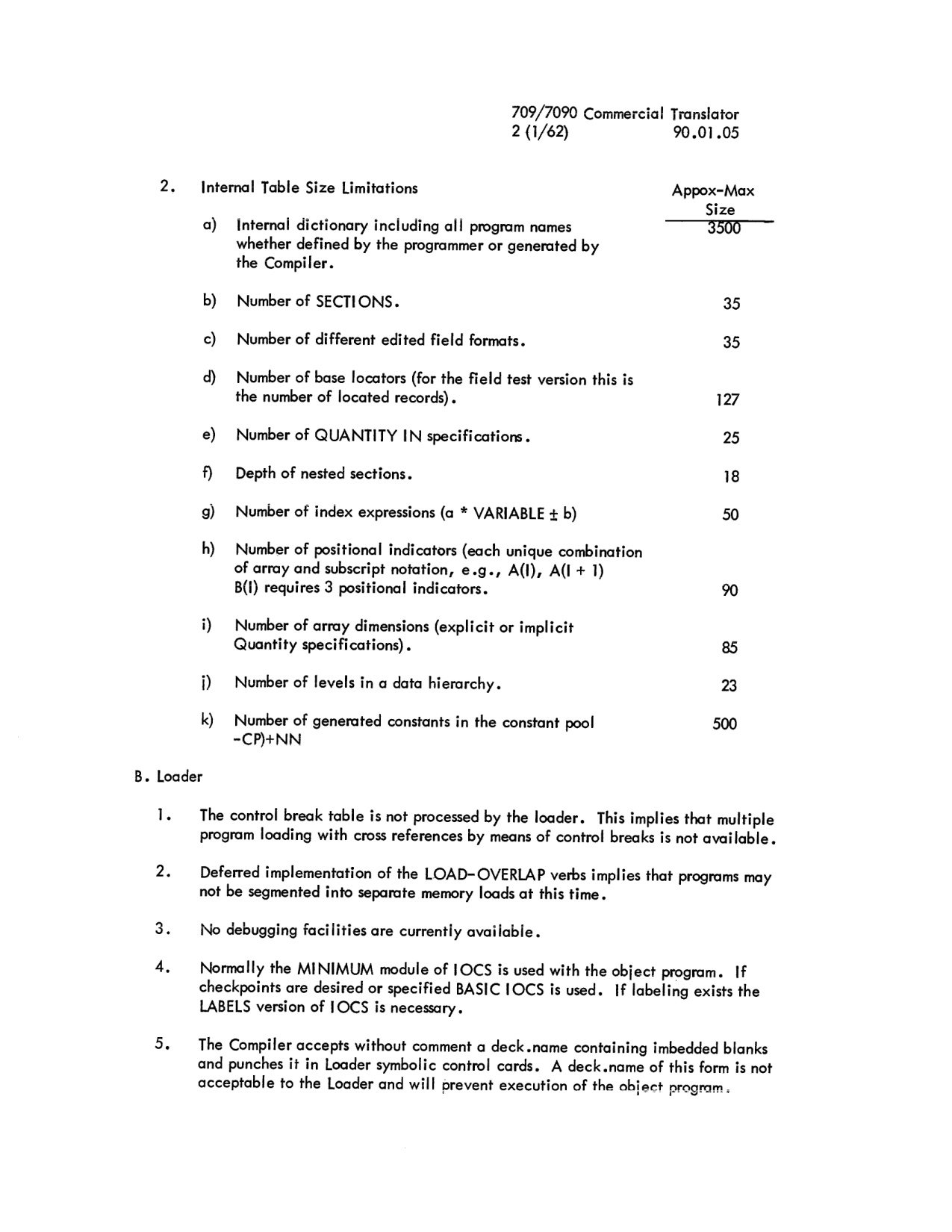
2. Internal Table Size Limitations
| Appox-Max Size | ||
|---|---|---|
| a) | Internal dictionary including all program names whether defined by the programmer or generated by the Compiler. | 3500 |
| b) | Number of SECTIONS. | 35 |
| c) | Number of different edited field formats. | 35 |
| d) | Number of base locators (for the field test version this is the number of located records). | 127 |
| e) | Number of QUANTITY IN specifications. | 25 |
| f) | Depth of nested sections. | 18 |
| g) | Number of index expressions (a * VARIABLE ± b) | 50 |
| h) | Number of positional indicators (each unique combination of array and subscript notation, e.g., A(I), A(I + 1) B(I) requires 3 positional indicators.) | 90 |
| i) | Number of array dimensions (explicit or implicit Quantity specifications). | 85 |
| j) | Number of levels in a data hierarchy. | 23 |
| k) | Number of generated constants in the constant pool -CP)+NN | 500 |
B. Loader
-
The control break table is not processed by the loader. This implies that multiple program loading with cross references by means of control breaks is not available.
-
Deferred implementation of the LOAD-OVERLAP verbs implies that programs may not be segmented into separate memory loads at this time.
-
No debugging facilities are currently available.
-
Normally the MINIMUM module of IOCS is used with the object program. If checkpoints are desired or specified BASIC IOCS is used. If labeling exists the LABELS version of IOCS is necessary.
-
The Compiler accepts without comment a deck.name containing imbedded blanks and punches it in Loader symbolic control cards. A deck.name of this form is not acceptable to the Loader and will prevent execution of the object program.