The text read off it
[page 3]
The Commercial Translator System
The initial definition of a business data processing problem usually involves some type of flow chart, often combined with a written description of the procedure to be followed. In order to be handled by a data processing machine, the procedure must be expressed in the machine's own coded, elementary instructions. In the past, it has been necessary for the programmer to make the translation between these two markedly different languages. Learning to do so is a matter of many months of training and experience.
The Commercial Translator makes it possible to let the machine itself do much of this translation. Now, we need only restate the procedure in a series of formal procedure statements and then let the Commercial Translator processor carry out the remainder of the translation to produce actual machine instructions.
Stated in the terms we shall use in this manual, the Commercial Translator processor (which is itself a specialized program) converts from a source language (the procedure statements) to an object language (the machine instructions).
An important advantage of writing procedure statements in the Commercial Translator language is that they do not depend on the characteristics of the data processing machine on which they will be used. In the terminology of the field, we would say that the procedure statements are machine-independent. For each type of machine there must be an associated processor, but the different processors will all accept the same procedure statements. This naturally means that transferring a problem from one machine to another is a far simpler task than before.
Along with the procedure description, we must provide the processor with a data description which describes the problem data. The data description is not entirely machine independent, but rather depends to some extent on the characteristics of the type of machine being used; it probably will need some revision if it is necessary to transfer the problem to a different machine.
It turns out to be a major advantage that the procedure description and the data description are separate because changes are much easier to make. With this independence, if a modification of the procedure is required, we do not have to change the data description; we simply change the affected part and use the processor again. Correspondingly we can change the data description without modifying the procedure.
Examples
The examples which follow introduce the fundamental concepts of Commercial Translator procedure description and data description. It is not intended that these examples should present all of the information about the Commercial Translator language; later parts of this manual do that. This part is intended only to introduce the subject in a manner which may facilitate learning.
Example 1
The central feature of a billing procedure is the multiplication of the unit price by the quantity sold. A sentence in a Commercial Translator program to do this could be:
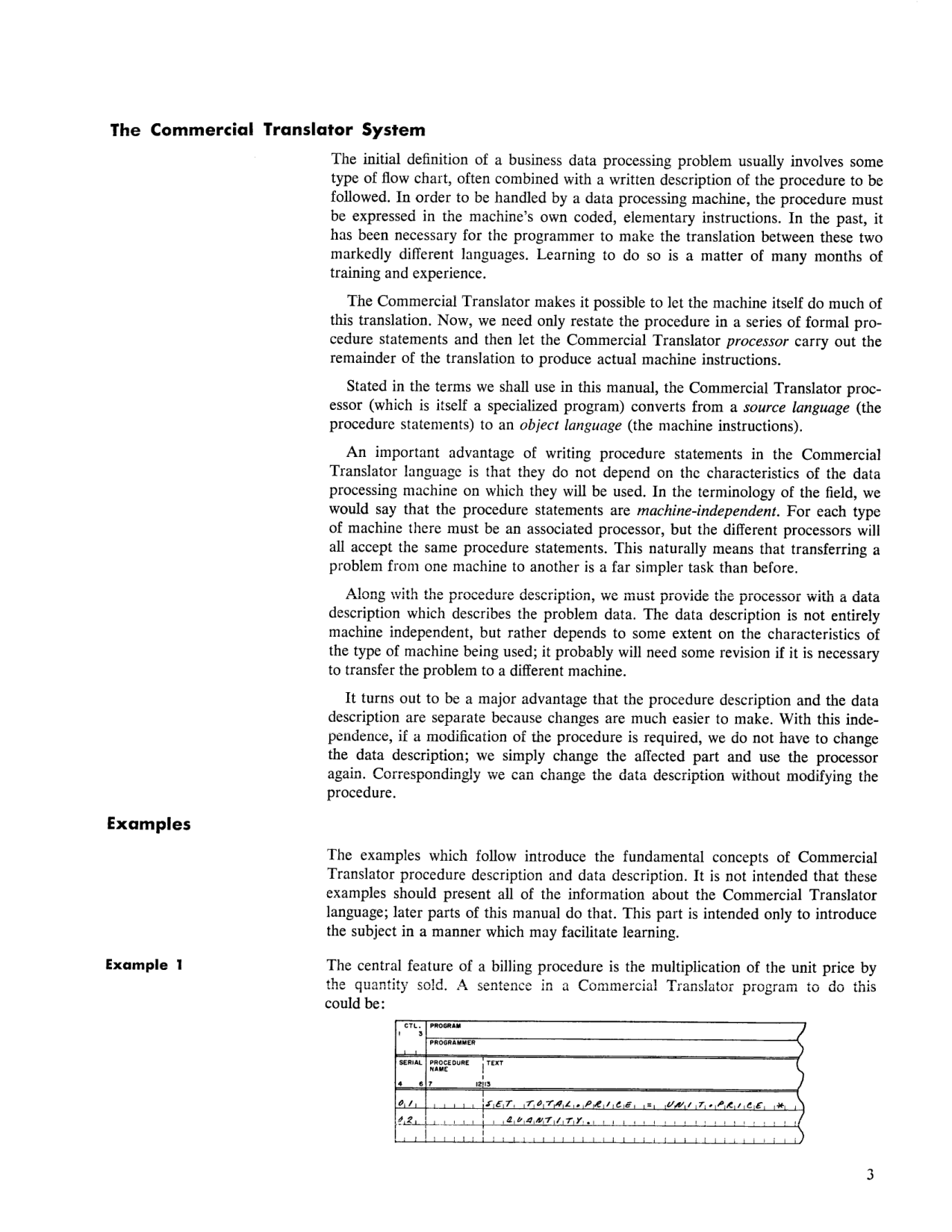 Coding-form facsimile: Example 1 procedure statement (page 3).
SERIAL   PROCEDURE NAME        TEXT
 01                             SET TOTAL.PRICE = UNIT.PRICE *
 02                             QUANTITY.